
Mechanics, Mechanisms and Maladaptations

Mechanics, Mechanisms and Maladaptations
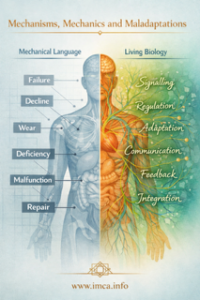
I’m curious when we first started talking about our bodies as if they were nothing more than machines ticking away?
The question came to me after a conversation with a woman who rang asking for help. She spoke in a rush, the way you do when something has been simmering inside for years. She poured out everything wrong with the NHS, with doctors here in Britain, with how women are so often dismissed, hurried along, given a prescription and shown the door. I felt that anger straight away. So many of us do.
Yet beneath it all lay this quiet contradiction.
She wanted help, yes, but not really an explanation. Perhaps she unconsciously, was still caught in the familiar choice of red pill or blue pill and simply wanted the ease. The pill.
She went through her symptoms one by one, describing what her body was doing, and then she said it with such certainty.
“It’s mechanical. It’s just aging.”
Those words stayed with me.
There is a persistent claim that symptoms emerging during menopause have nothing to do with emotions, conflicts, or lived experience. The argument goes something like this: the body simply ages, hormones decline, tissues wear out, and what follows is an unavoidable mechanical process. According to that view, hot flushes, insomnia, mood shifts, joint pain, metabolic changes, and brain fog are simply the predictable outcome of ovarian senescence.
The difficulty with that argument is that biology does not behave like a machine. Human physiology is regulatory, adaptive, and responsive to environment, perception, and experience. Hormones do not operate in isolation. They sit inside an integrated network that includes the nervous system, the immune system, the endocrine system, and the brain’s threat detection and meaning making circuits.
Menopause itself is biologically defined as the cessation of ovarian follicular activity and the decline of estradiol and progesterone production. That part is factual. However the experience of menopause varies dramatically between individuals and across cultures. Some women pass through the transition with minimal disturbance. Others experience years of severe physiological disruption. If the process were purely mechanical, the symptom pattern would be far more uniform.
Research repeatedly shows that stress biology alters the very hormonal systems involved in menopause. The hypothalamic pituitary adrenal axis interacts directly with the hypothalamic pituitary gonadal axis. Cortisol, inflammatory cytokines, sleep disruption, metabolic stress, and long term emotional strain all influence how ovarian hormones fluctuate and how tissues respond to those fluctuations.
Estradiol receptors are present in the brain, bone, blood vessels, immune cells, and connective tissue. When estrogen levels change, these systems adapt. However their adaptive capacity is shaped by the terrain they are already operating within. Chronic stress, trauma history, inflammatory load, metabolic health, and nervous system regulation all influence how smoothly that adaptation occurs.
Anthropological research adds another layer to this discussion. In some cultures menopausal symptoms such as severe hot flushes or emotional volatility are rare. In others they are common. Lifestyle, diet, social structure, perceived value of aging women, and psychological stress appear to influence symptom expression. Again, this variation would not exist if menopause functioned as a simple mechanical failure of the ovaries.
None of this means menopause is “all emotional”. That claim would be just as inaccurate as saying it is purely mechanical. Hormonal shifts are real. Tissue responses are real. Aging biology is real. What the evidence shows is that physiology sits inside a dynamic system shaped by stress signalling, perception, environment, and internal regulation.
Maladaptations?
That word appears more and more in the literature. When the mechanical explanation begins to fall apart, the language often shifts and the symptoms are described as maladaptive responses, the body supposedly adjusting badly to its environment. Yet even this framing quietly carries the same assumption as the mechanical model: that the body has somehow got it wrong.
From a biological perspective cells are constantly adapting. Regulation is continuous. Signalling never stops. To describe these responses as maladaptive is already to imply that the body has made a mistake.
More on that in Part 2.
Our nervous system never stops reading the room. Safety or threat. Belonging or isolation. Pressure or ease. Those interpretations alter neurochemical signalling, immune function, metabolic pathways, and hormone release. Over decades the cumulative effect of those signals influences how the body moves through major biological transitions such as puberty, pregnancy, and menopause.
A more accurate description is that menopause is a biological transition occurring within a living regulatory network. Hormones change. The brain adapts. The body recalibrates. The terrain in which that recalibration occurs determines whether the transition is relatively smooth or profoundly symptomatic.
Framing menopause as purely mechanical oversimplifies human physiology. Framing it as purely emotional does the same. The body is neither a broken machine nor a floating emotional construct. It is a responsive biological system that records experience, adapts to stress, and reorganises itself across the lifespan.
Which brings me back to that conversation, and to the question that would not leave me.
Where did this picture come from, the body as a machine that simply wears out with age?
For most of human history the body was not described this way. Greek physicians spoke of humours in flux. Chinese medicine described qi moving through channels. Ayurvedic traditions explored the balance of doshas. These systems were imperfect in many ways, yet they all understood physiology as something dynamic and relational rather than mechanical.
The language of the body as a machine began to take hold during the scientific revolution. Philosophers such as René Descartes separated mind and body, allowing the body to be examined as a physical mechanism. Soon afterwards physicians like William Harvey described the circulation of blood and compared the heart to a pump. Those metaphors proved enormously useful and helped launch modern medicine.
During the industrial revolution the language intensified. In a world organised around engines and machinery, organs came to be described as pumps, filters, and regulators. Disease became the failure of a component. Treatment became the repair or replacement of the malfunctioning part.
This model produced extraordinary advances. Surgery, antibiotics, imaging, and pharmacology all emerged from that way of thinking.
However it also shaped how we interpret symptoms.
When the body is viewed primarily as a machine, discomfort is understood as mechanical failure. Something must be broken. Something must be fixed. A pill becomes the logical answer.
That is why that woman’s words stayed with me. She was deeply frustrated with the medical system, yet she was still speaking its oldest language.
Mechanical aging. Mechanical solutions.
The irony is that modern biology increasingly points toward something quite different. Systems biology, neuroendocrinology, epigenetics, and psychoneuroimmunology all point to the same conclusion. The body is not a collection of separate parts but an interconnected network constantly communicating with itself and with the environment.
Which leaves a far more interesting question.
Not whether aging is mechanical.
But what allows the body to adapt well to aging, and what makes that adaptation more difficult?
That is where the deeper exploration begins.




Responses